
How Much Does Dog Training Cost in Chicago in 2026?
Short answer: a board and train in Chicago runs roughly $900–$1,100 per week, usually booked in three- to four-week blocks. Private sessions run $80–$200 per hour. A six-week group class runs $200–$400. Daycare and training lands below board and train and can reach the same result for the right dog.
That's the number you came for. The rest of this post is the part that actually matters — why those numbers vary so wildly, and how to tell whether the price in front of you is buying you a trained dog or just buying you time.
Prices went up, and nobody regulated the climb
Board and train pricing has moved a lot over the last decade-plus. Back in 2012, it was very common to see a two-week boot camp advertised at $1,200. Then things kept increasing. More facilities opened. The dog industry as a whole boomed and kept growing. Prices followed.
Here's the uncomfortable part: there is no governing body setting the rate. Dog training is an unregulated industry. It is genuinely easy for a trainer to charge a large sum of money simply because they feel like it — or because they looked at a competitor's website and saw a number there, so they put that number on their own.
So there is often no rhyme or reason to what things cost. Two facilities eight miles apart can charge the same $4,000 for four weeks and deliver completely different dogs back to you.
And that creates the real problem for owners: it is very hard to judge what good dog training is and what bad dog training is until you've experienced good dog training. Most owners have no reference point. They can't evaluate the product before they buy it, and often can't fully evaluate it after, either.
Our honest opinion, from running a facility: a lot of dog trainers are not good dog trainers. Not because they don't care — most of them care a great deal. It's because they can't reliably reach a goal. They don't have a recipe for reaching goals, or a repeatable process for getting a specific dog from where it is to where it needs to be. They have a philosophy and a set of tools, but not a system.
That's the gap price is supposed to signal, and frequently doesn't.
What you're actually buying: the vehicle, not the training
Something that gets lost in every price comparison: at a good facility, every dog gets trained the same way. The training itself isn't the variable. What varies is the delivery vehicle.
At Found, we start every dog with the same process — make sure the dog is ready to train, teach behaviors, motivate behaviors. We will not touch behavioral cases, aggression, or anything of the sort until the dog knows behaviors and has the ability to understand what we're trying to stop and how we're trying to improve. Foundation first, fair to the animal, positive reinforcement. That doesn't change based on what you pay.
What you're choosing when you pick a program — and what you're paying for — is who does the work, and how much of it lands on you.
That reframes the whole pricing question. It's not "what's the cheapest way to get my dog trained." It's "how much of this am I realistically going to do myself, and what happens to my money if I don't?"
The four vehicles, and what each one costs in 2026
Private sessions — $80 to $200 per hour
Private sessions break down to us teaching you how to train your dog, so you can apply those skills daily — before work, after work, whenever you can make the time. Essentially, we're training you to become the dog trainer, so that you can train your dog.
Expect $80 to $150 an hour at the common end, and up to $200 an hour depending on who your trainer is and what you're trying to solve. Very few people can actually make meaningful improvement in aggression cases, and sometimes prices reflect that.
If you're paying a premium, make sure the premium is justified — by the actual technique the trainer employs, the experience they bring, and the communication and support that should be part of any real program. Premium price with no premium process is just a number on a website.
The trade-off: we teach you how to train the dog, but we expect you to be consistent at home. When you are, you'll see the improvement and we pick up from there in the next session. When you're not, you're paying $80–$200 an hour to repeat last week.
Group classes — $200 to $400 for a six-week course
We look at group classes as a little bit of speed dating. You come in, you're with a group of people, you practice as a group, and while you're practicing you learn a thing or two.
They can be challenging for certain dogs — reactivity, anxiety, or a dog that's struggling to acclimate to the environment. The trade-off is that you get real distractions to work around, and it comes down to you becoming a genuinely good handler who can work your dog in different situations.
Honestly, we recommend group classes mainly for board and train graduates, daycare training graduates, or dogs that completed training elsewhere and can demonstrate the skills. Group class as a first-time owner's first exposure to training is often a frustrating experience. There's so much to learn, one hour to deliver the information, and weeks of conditioning required for any of it to stick.
Daycare and training — less than board and train, same destination
Daycare and training is for the dog that can come in, adjust well, has behaviors that need to be taught, and can go home at night. The training happens at the facility during the day; the dog goes home with you at night.
You can expect to pay less than a board and train and achieve the same results — assuming your dog adjusts to the environment and builds new relationships easily, and assuming you can follow a routine at home that doesn't undo what we did during the day. That second assumption is where this program lives or dies.
Board and train — $900 to $1,100 per week
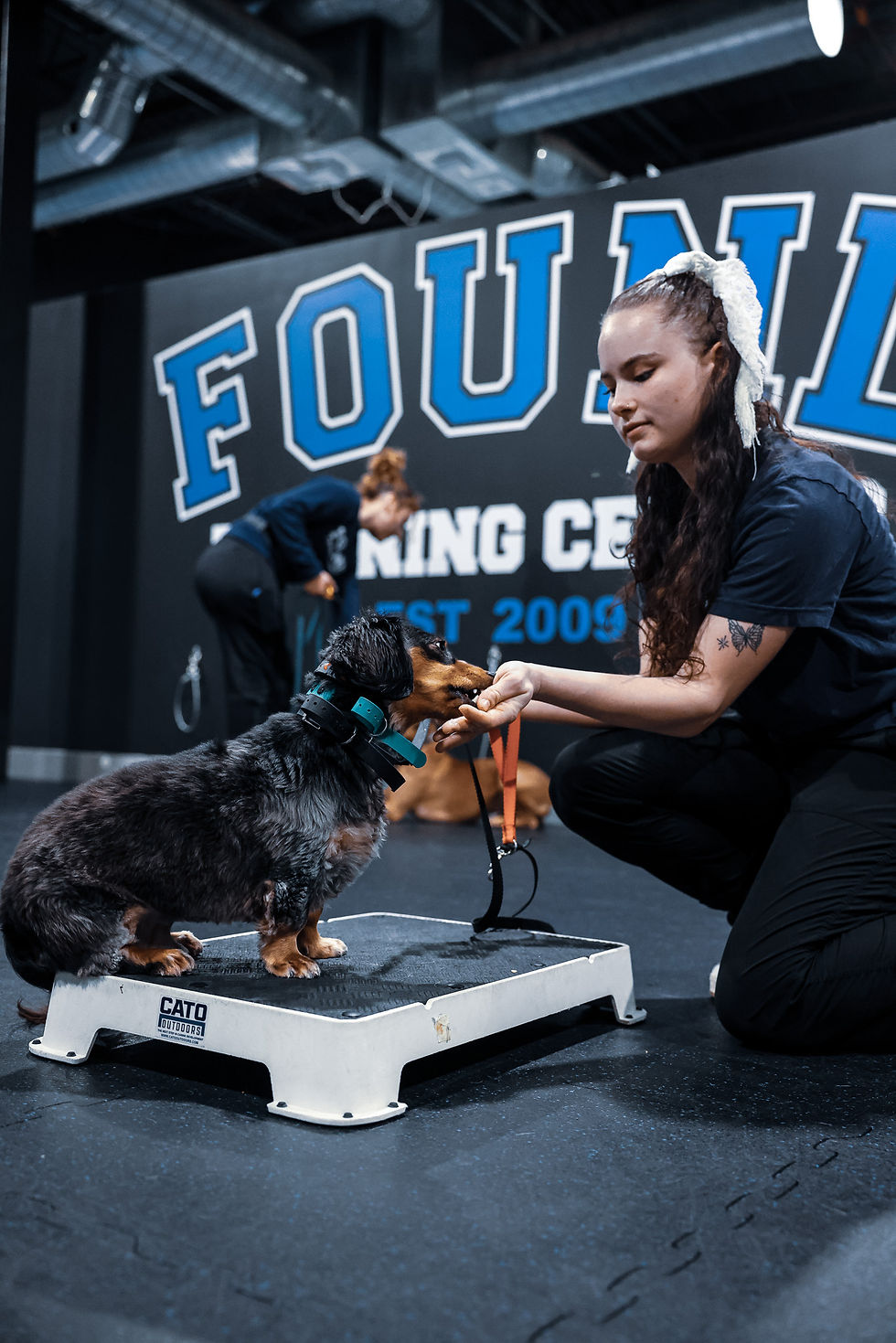
This is where we take it upon ourselves to do everything. Your dog goes through an acclimation process, we take care of them through the week, exposure trips, the whole thing. It's the immersive experience, and to be honest, it's probably the best way to train a dog.
Expect $900 to $1,100 per week, typically booked in blocks of three to four weeks.
We'll say this plainly, because a lot of places won't: we believe anything beyond four weeks is unnecessary. The exceptions are a severe behavior case going home with a trainer, or a puppy — puppies unfortunately tend to stay puppies for a while. If someone is quoting you eight or twelve weeks for a standard obedience or manners goal, ask them exactly what happens in weeks five through twelve.
The 2026 Chicago price table
Service | 2026 Chicago range | Best for |
|---|---|---|
Private sessions | $80–$200 / hour | Owners with dog experience, time, and consistency at home |
Group classes | $200–$400 / six-week course | Graduates of a training program; proofing and handling skills |
Daycare and training | $650 - $900/ week | Dogs that acclimate easily; owners who can hold a routine at home |
Board and train | $900–$1,100 / week (3–4 weeks typical) | First-time owners, busy households, behavior cases, fastest reliable result |
Why the "cheap" option is frequently the expensive one
Here's the math almost nobody does.
Training a dog is far more than handing out treats and going through the motions. You have to get the dog into a state of drive, into a state of excitement. You have to build a relationship. You have to teach behaviors while keeping the dog motivated, with timing that's actually appropriate, at the moment that's actually right. It takes real energy management on behalf of the dog, technique, a level of education, and a lot of reading of body language.
Which means you can do a lot of dog training and have none of it stick. You can sit there for a long stretch of time and achieve nothing, simply because your dog wasn't in a mindset to learn for any of the time you were training it.
That's what happens in a lot of group classes. That's what happens in a lot of private sessions. It's why owners end up frustrated and conclude the training was bad — when what really happened is that nobody in the room understood the science of what makes a dog learn.
So when you add up the total money and total effort you'll spend on private sessions or group classes to genuinely change your dog's behavior, it often exceeds simply paying for a complete board and train or daycare and training experience. That's a large part of why we push training in that direction. We just see better results for the dogs, and we see owners who are honestly a bit dumbfounded at how much can change in a short amount of time.
Dog training is not mystical. It's not a vibe gifted to certain people. It's a science, and we break that science down over and over again. As the years go by, the science gets more precise.
How to choose, if you put yourself in the owner's shoes
Skip "what's cheapest" and ask what's an effective investment.
If you're good at handling, have training experience, and have owned dogs before — a few private sessions or a daycare and training program is very reasonable. You have the skills to hold up your end.
If this is your first dog, or you don't have the time — do a board and train. Everything gets tackled, and there's a lot of support and information that comes with it.
And whichever you choose, hold the program to this standard: at the end of an immersive program you should be getting back a dog you have been taught how to handle — not a dog you still feel you have to train after paying thousands of dollars. If a facility hands your dog back at the curb with a packet and a wave, the price was wrong no matter what it was.
The honest summary
Dog training in Chicago in 2026 costs what it costs largely because nobody stopped it from costing that. Within those ranges, the real variable isn't the dollar figure — it's whether the trainer has an actual process for getting your specific dog to an actual goal.
Ask what the process is. Ask what happens in week three. Ask what you'll be able to do with your dog when it's over. The answers will tell you more about the price than the price does.
We hope this helps — and we hope to see you at Found Chicago.
Not sure which program fits your dog? Book an evaluation with our team and we'll tell you honestly which vehicle gets you there — including when that's the less expensive one.

Comments